|
|
Home / Articles >
|
Supersonic Low-Altitude Missile
The SLAM (Supersonic Low Altitude issile) was designed to complement the doctrine of mutually assured destruction, and as a possible replacement for or to augment the Strategic Air Command system. The use of a nuclear engine in the airframe gave the missile an unprecedented range, estimated to be roughly one hundred and thirteen thousand miles (almost 182000 km or over four and a half times the equatorial circumference of the earth).
The idea behind any ramjet is relatively simple: air is drawn in at the front of the vehicle under ram pressure, heated to make it expand, and then exhausted out the back, providing thrust. But the notion of using a nuclear reactor to heat the air was something fundamentally new. Unlike commercial reactors, which are surrounded by hundreds of tons of shielding, SLAMs reactor had to be small and compact enough to fly, but durable enough to survive the several thousand-mile trip to targets in the Soviet Union.
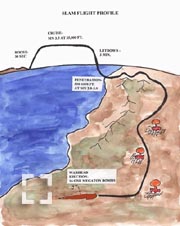
SLAM flight path
|
This highly innovative engine concept was developed under the aegis of a separate project code-named Project Pluto. Special ceramics had to be developed to meet the stringent weight and tremendous heat tolerances demanded of the SLAM's reactor. These were developed by the Coors Porcelain Company, better-known later for their brewery division. The reactor itself was designed at the Lawrence Radiation Laboratory.
Pluto's namesake was Roman mythology's ruler of the underworld -- seemingly an apt inspiration for a locomotive-size missile that would travel at near-treetop level at three times the speed of sound, tossing out hydrogen bombs as it roared overhead. Pluto's designers calculated that its shock wave alone might kill people on the ground. Then there was the problem of fallout. In addition to gamma and neutron radiation from the unshielded reactor, Pluto's nuclear ramjet would spew fission fragments out in its exhaust as it flew by. One enterprising weaponeer had a plan to turn an obvious peacetime liability into a wartime asset: he suggested flying the radioactive rocket back and forth over the Soviet Union after it had dropped its bombs.
Because of its combination of high speed and low altitude, Pluto promised to get through to targets that manned bombers and even ballistic missiles might not be able to reach. What weaponeers call "robustness" was another important advantage. It was because of the missile's low complexity and high durability that physicist Ted Merkle, the project's director, called it "the flying crowbar."
Another revolutionary aspect of the SLAM was its reliance on automation. It would have the mission of a long-range bomber, but would be completely unmanned: accepting radioed commands up to its failsafe point, whereafter it would rely on a Terrain Contour Matching (TERCOM) radar system to navigate to preprogrammed targets.
Tory-IIA
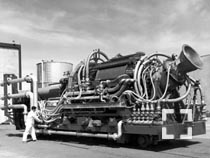
Tory II
|
So many unknowns surrounded Pluto that Merkle decided that it would take a static test of the full-scale ramjet reactor to resolve them all. To carry out the tests, Livermore built a special facility designated Site 401 on Jackass Flats, in what is now known as the Nevada Test Site. The location of the majority of the USs continental atmospheric nuclear weapon tests.
Since Pluto's reactor would become intensely radioactive when run, a fully automated railroad had to be constructed to move the reactor the nearly two miles that separated the static test stand from the massive disassembly building, where the "hot" reactor would be taken apart and examined by remote control. Scientists from Livermore would watch the reactor tests on television in a tin shed located far away from the test stand.
Just to supply the concrete for the six- to eight-foot-thick walls of the disassembly building, the U.S. government had to buy an aggregate mine. It took 25 miles of oil well casing to store the million pounds of pressurized air used to simulate ramjet flight conditions for Pluto. To supply the high-pressure air, the lab borrowed giant compressors from the Navy's submarine base in Groton, Connecticut. For a five-minute, full power test, as much as a ton of air a second had to be forced over 14 million one-inch steel balls in four huge steel tanks raised to 1,350 degrees Fahrenheit by oil-burning heaters.
On the 14th of May, Tory-IIA was run for only a few seconds, and at merely a fraction of its rated power. But the test was deemed a complete success. Three years later Tory-IIC was for five minutes at full power, producing 513 megawatts and the equivalent of over 35,000 pounds of thrust. Returning to the lab, Merkle concentrated on making the reactor lighter, more powerful, and compact enough to be test-flown. There was even excited talk of a Tory-III, capable of propelling the missile to Mach 4.
Outcome
Meanwhile, at the Pentagon, Pluto's sponsors were having second thoughts about the project. Even before it began dropping bombs on our enemies Pluto would have deafened, flattened, and irradiated our friends. The noise level on the ground as Pluto went by overhead was expected to be about 150 decibels. Ruptured eardrums, of course, would have been the least of your problems if you were unlucky enough to be underneath the unshielded reactor when it went by, literally roasting chickens in the barnyard. Pluto had begun to look like something only Goofy could love.
The SLAM program was scrapped by the Department of Defense and the State Department on July the 1st 1964. By this time serious questions about its safety had been raised, as well as its efficacy and cost. It was believed by many that if the U.S. deployed a missile of such awesome and reckless power, then the Soviets would be compelled to do so too. ICBMs promised a cheaper, faster delivery to targets, and because of their speed (Mach 12) and trajectory were considered virtually unstoppable. The SLAM was also being outpaced by advances in defensive ground radar, which threatened to render its stratagem of low-altitude evasion ineffective.
For some at Livermore, a lingering nostalgia about Pluto remains. "It was the best six years of my life," says William Moran, who oversaw the production of the Tory fuel elements. Chuck Barnett, who directed the Tory tests, succinctly sums up the spirit at the lab: "I was young. We had lots of money. It was very exciting."
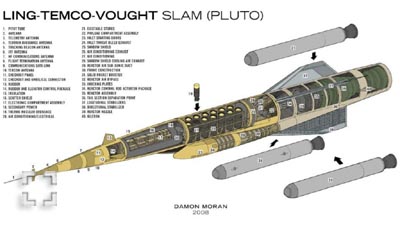
Schematic
|
|
|
|
|