|
|
Home / Articles >
Huron King - 24/06/1980
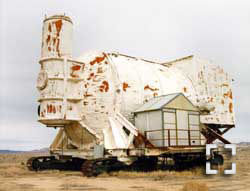
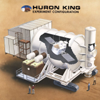
Huron King test chamber
|
The Nevada Test Site in Nye County, Nevada, about 65 miles northwest of the city of Las Vegas, is scattered with relics from the United States’ nuclear age. Nearly a thousand nuclear tests were conducted there, of which about a hundred were atmospheric. Mushroom clouds from these tests were visible and their tremors were felt as far away as Las Vegas.
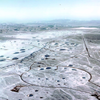
In the early 1960s, concern for fallout drove the tests underground, and for the next three decades more than nine hundred sub-surface nuclear devices were exploded leaving a landscape resembling the surface of the moon. Saucer-shaped craters are formed when the ground subsides after an underground cavity is formed, especially the Yucca Flat, where the bulk of the tests took place. Aside from craters such as the 390 meter Sedan crater, there are also various abandoned hardware and objects such as a bank vault which can be seen on the Nevada National Security Site tour.
Other unused relics at NTS include the partially assembled cabling, towers and equipment for shot 'Icecap' in Area 1 and shot 'Gabbs' in Area 2. Equipment intended for Shot 'Greenwater' gathers dust in Area 19 at Pahute Mesa. 'Icecap' which was to be a joint US-UK test event.
One particularly interesting relic is An assortment of buildings, including residential houses and electrical substations, were constructed at the site nicknamed 'Survival Town'. The buildings were populated with mannequins, and stocked with different types of canned and packaged foods. Not all of the buildings were destroyed in the blast, and some of them still stand at Area 1, Nevada Test Site. A short film about the blast, referred to as 'Operation Cue', was distributed by the Federal Civil Defense Administration.
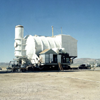
Another relic of the nuclear tests, but not part of the tour, is a large vacuum chamber that was built for the 'Huron King' nuclear test in 1980.
Electromagnetic Pulse
The Huron King test was intended to address concerns about how atmospheric nuclear detonation might affect military communication satellites. A nuclear explosion produces a large electromagnetic pulse (EMP), that can be used by an enemy to inflict secondary damage upon electrical and electronic systems by generating high levels of current and voltage surges to burn out sensitive electrical components. EMPs can devastate and render functionless any modern society that relies on electricity by knocking out their power grid and disrupting communication equipment.
In 1962, the US conducted a high-altitude nuclear test called Starfish Prime as part of Operation Fishbowl, where a 1.45 megaton bomb was detonated 400 kilometers 29 kilometers southwest of Johnston Island. 1,400 kilometers away in Hawaii, the EMP blast knocked off streetlights, set off burglar alarms and damaged a microwave link. In the months following the Starfish Prime test, at least six low Earth orbit satellites failed due to radiation damage, including the one that was launched prior to the test to measure the distribution of radiation produced by the blast.
In the Soviet Union similar research on EMP was being conducted. The same year Starfish Prime took place, Soviet scientists detonated a 300 kiloton bomb at an altitude of 290 km above Kazakhstan. To measure the effects of the EMP arising from the blast, they strung a 570 kilometer-long overhead telephone line and fitted them with fuses and gas-filled overvoltage protectors. The EMP from the test caused all the fuses to blow and all of the overvoltage protectors to fire along the entire length of the test-line. Furthermore, the EMP set on fire the electrical power plant in the city of Karaganda by inducing currents in a 1,000 km long shallow buried power cable.
Despite the lower yield of the bomb, in comparison to that of Starfish Prime, the EMP damage caused by the Soviet bomb was much greater because the tests were conducted over a large populated landmass, and the earth’s greater magnetic field at the location also assisted to concentrate the effects of the EMP.
Operation Tinderbox
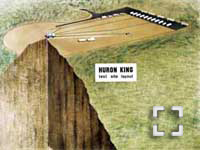
Test diagram
|
Operation Tinderbox was a series of fifteen nuclear tests conducted at the Nevada Test Site between 1979 and 1980, the 11th of these tests was known as Huron King conducted on the 24th of June 1980. The objective was to measure and quantify the damage an EMP blast could inflict on a military satellite, and whether the shielding techniques used were adequate to deflect such an attack. Because atmospheric nuclear testing was prohibited, the engineers devised a novel solution. The test would take place underground, with a military communications satellite suspended directly over the exploding device. The satellite was housed inside a giant 50-ton vacuum chamber built in order to simulate the vacuum of space. This vacuum chamber was nicknamed Tinderbox.
A 3000 meter shaft was drilled with a 20-kiloton device placed at the bottom of it. The Tinderbox, which was mounted on treads to make it movable, was parked at the top of the shaft and connected to the shaft by a vertical section. At zero time, the radiation from the device flowed up the vertical pipe to the surface test chamber. Mechanical closures then intercepted and sealed the pipe, preventing the accompanying shock wave from damaging the targets. The test chamber was then immediately disconnected by remote control from the pipe and winched to safety before the ground subsided to form a crater.
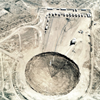
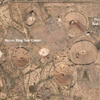
An inspection of the satellite after the test showed that the EMP shielding had worked as intended, and the satellite suffered no severe loss of functionality. The Huron King test cost USD 10.3 million in 1980 (equivalent to $40.3 million in 2025). The test chamber was never used again. You can still see it in satellite images (the site is off-limits to visitors) standing among the craters, 600 meters from its original location. It stands isolated in the middle of the Nevada desert, about 40 kilometers north of Mercury, a closed village and the gateway to the Nevada Test Site.
|
Click on a thumbnail for a larger version
|
|
|
|
|