 |
|
Home / Articles >
|
Atomic Photography
Between 1945 and 1963, almost all nuclear testing was conducted in the atmosphere, until the Partial Test Ban Treaty of 1963 banned atmospheric testing. During the atmospheric testing era, still and motion picture photography were the primary methods of recording and analysing nuclear explosions. Photographs provided scientific data essential in ascertaining their yield, efficiency, effects and how best to deploy them. Much of the photographic equipment used predated the start of nuclear testing, though their application and the film used required significant development.
The process of converting the physics package inside a nuclear weapon into a ball of plasma hotter than the centre of the sun, takes around 20 millionths of a second. Needless to say, specialized equipment is required to record events of this magnitude and short duration. For reference, within one second of detonation, the fireball generated by the 15 megaton Bravo test in 1954 was over 7km in diameter.
History
Trinity
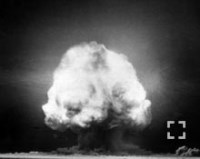
Trinity 16/07/1945
|
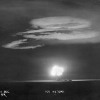
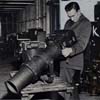
The first atomic bomb test codenamed Trinity, was conducted in the Alamagordo desert New Mexico on the 16th of July 1945. The responsibility for capturing this event was given to Los Alamos Optics Division headed by Julian Ellis Mack. Based initially at the Los Alamos Anchor Ranch site, Mack and his team which included Berlyn Brixner developed and tested the cameras ultimately used at Trinity. Improving upon existing rotating, high-speed camera technology, Mack invented the 'Mack Streak Camera', a rotating mirror camera capable of capturing images at one ten-millionth of a second intervals (100 nanoseconds).
Various teams at Los Alamos developed techniques not just to record the tests, but ones that were integral to the development of the weapon systems themselves. High speed cameras were used to analyse problems with with uranium 'gun-type' bomb design. X-ray flash photography was crucial in developing the implosion system used in the Trinity test device, in a series of tests known as the RaLa Experiments.
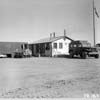
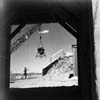
The majority of the photographs taken used 8mm black and white film such as Panatomic X, ASA-30, Super Double X, and Plus X. The cameras were positioned as close as 800m from ground zero and as far as 22km away. There were two sites north of ground zero, two sites west of ground zero, one at 700m and one at 9km. There was also another located approximately 23km away. As this was the first time capturing such an event, some educated guesswork was involved anticipating which setup would work best. The approach taken was to use as wide a range of film types, lenses and exposure times as possible.
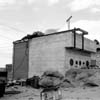
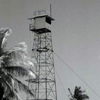
Fifty-two remotely triggered cameras were used to capture the Trinity test on film, positioned across four photo bunkers. Of the 52, only 11 produced usable images, with much of the film being solarized and blistered by the intense light of the explosion.
According to Julian Mack’s 1946 report, the cameras used were -
3 x 8mm Fastax
6 x 16mm Fastax (10,000 fps)
3 x 16mm Fastax Primocard
4 x 35mm Mitchell (144 fps)
24 x 16mm Kodak Cine 'E'
2 x Fairchild K-17B Aero
4 x stereographic Fairchild K-17B Aero
2 x Pinhole Cameras
3 x Shock Switch Cameras.
Fastax cameras taking 10,000 frames per second would record the minute details of the explosion, with each frame lasting only 100 microseconds. Spectrograph cameras would record the wavelengths of light from the explosion, and pinhole cameras to record gamma rays. Observer Jack Aeby smuggled in his 35 mm Perfex 44, and took the only known well-exposed colour photograph of the detonation using a few frames of Anscochrome colour film he had left. Mack and Brixner had the foresight to position a civilian, Neil York, 32km northwest of the detonation, who took some haunting images with a stills camera.
Julian Mack captured a number of images with a pinhole camera which have survived, despite confusingly stating in his report - "film blank, reason unknown".
A number of rolls of 35mm Pan-X black and white film were exposed known as 'Newsreel rolls' using Mitchell cameras. All in approximately 100,000 images were taken.
|
Click on a thumbnail for large image
|
Photography of atomic weapons continued with the attacks on the Japanese cities of Hiroshima and Nagasaki 20 days after the Trinity test.
Hiroshima and Nagasaki
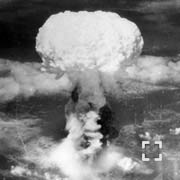
Nagasaki 09/08/1945
|
During the attack on Hiroshima in 1945, physicist Bernard Waldman was the camera operator on the observation aircraft Necessary Evil. He was equipped with a high-speed Fastax camera with six seconds of film in order to record the blast. No usable footage was produced, either due to operator error, issues with the equipment, or problems with the film development. It is not clear which.
The only motion pictures of the mushroom cloud were taken by Harold Agnew aboard observation B-29 'The Great Artiste'. While Sergeant George Caron took the definitive photographs of the cloud from the tail gunner position of the Enola Gay using his personal camera.
B-29 'Big Stink' (later renamed Dave's Dream) took off to observe the attack on Nagasaki. Los Alamos physicist Robert Serber was supposed to be onboard, but was left behind as he had forgotten his parachute. Since he was the only crew member who knew how to operate the high-speed camera (the whole point of the aircraft's mission), aircraft commander Major James Hopkins had to be instructed by radio from Tinian on its use. The task of officially documenting the bombing was instead carried out by bombardier Charles Levy on the other observation plane The Great Artiste using his personal camera.
City residents made photographic records of both cities in the wake of the attacks, as did both US military and international press photographers.
The lack of photographic data was unfortunate, but understandable as they were combat missions not tests. This was addressed a year later during the first peace time atomic tests in the pacific during Operation Crossroads.
Crossroads
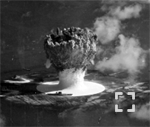
Baker - 24/07/1945
|
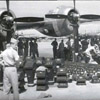
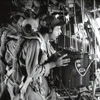
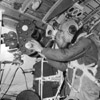
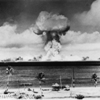
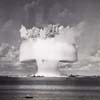
At the remote Pacific atoll of Bikini, operations were set up for the first large scale nuclear test series. This operation comprised of two tests: one above water (Able) and one below (Baker) detonated amongst a fleet of target ships. Cameras were positioned on the ground, in towers and aboard aircraft, with command systems to synchronize them. High speed cameras were deployed, as well as streak cameras and 48 inch aerial cameras capable of capturing extreme detail. Cameras were installed inside lead-walled vaults, the doors of which were arranged to close automatically after filming to protect the film from the damaging effects of gamma radiation. B-17 drone aircraft were equipped with hundreds of cameras and radio-controlled autopilots to capture images from the air.
The extreme humidity at Bikini presented a problem for the aerial photographers. As the photographic aircraft descended and the air pressure in the cabin increased, moisture would condense on the photographic film, destroying the emulsion. To avoid this problem, pilots descended very slowly, sometimes over a period as great as one hour. In many planes the difficulty was avoided by installing cameras in constant pressure chambers.
The photographic operations were conducted by the Photographic Engineering Section (Task Unit 1.52), led by Major Perry M. Thomas.
Over 150 movie cameras and 100 still cameras were used during Crossroads. More than 50,000 still pictures were taken, and 500,000 meters of motion picture film exposed. On the island of Kwajalein, a huge photographic laboratory was built, cooled and dehumidified to prevent damage to the film.
The underwater Baker test released unexpected levels of radioactive contamination, which complicated post-blast photography and survey efforts. The photography captured dramatic and historically significant images of the atomic blasts, including the Baker shot's massive water column and the subsequent damage to the fleet.
Operation Crossroads was the first nuclear test series to be publicly announced and observed by a large press contingent. The resulting images and films became a key tool in communicating the power of these new weapons to a global audience.
|
Click on a thumbnail for large image
|
Lookout Mountain
After Crossroads much of the experimental photographic work was subcontracted to allow Los Alamos scientists to focus on weapon design and production. From 1947 onwards, most films were produced by a top secret film unit known as Lookout Mountain Laboratory based in Hollywood. The four story facility featured a full sound stage, screening rooms, film processing labs, as well as animation and editing and storage capabilities. Cutting edge technical developments such as 3-D, Cinemascope, stereo sound and VistaVsion were tested at Lookout Mountain, sometimes before they were available to mainstream commercial studios.
The laboratory was responsible for the full production of films, from research and writing, to editing scoring and producing the final prints for release. The output of this unit rivalled Hollywood's major film studios, yet most were highly classified seen only by the military for technical analysis and training. Though the studio employed over 250 people, its existence remained unknown to the general public until the 1990s.
Between 1947 and 1969 Lookout Mountain Laboratory produced approximately 6,500 films primarily for the US Department of Defence and the Atomic Energy Commission. In 1997 the US Department of Energy (D.O.E.) declassified a number of these historically significant films, making available to the general public.
EG&G
In 1947 Harold Edgerton formed the company known as EG&G (Edgerton, Germeshausen and Grier). Edgerton had a background in cutting edge high speed photography and had developed photographic techniques for the US Airforce during World War II. EG&G was contracted to design and operate timing and control systems as well as the technical analytic photography during nuclear testing.
EG&G and researcher Charles Wyckoff developed the Rapatronic camera (rapid action electronic), capable of capturing an image lasting only one millionth of a second (1 microsecond). This camera uses two polarizing filters, which when stimulated by a magnetic field allowed light to pass, creating an 'magneto-electrical' shutter. The camera was triggered by a photocell that detected the initial x-rays from the weapon. This 'zero time' could then be delayed to capture an image at the required slice of time, the average exposure time being three microseconds.
The system only allowed for exposure on a single glass plate, so they were arranged in arrays of up to 16 to provide a sequence of images. High speed Fastax and Eastman cameras were capable of extremely high frame rates; however the Rapatronic camera 152mm glass plate format provided far higher quality images.
An experimental version of the Rapatronic camera was developed known as the 'Teletronic', which used a 4064 mm focal length optical system to capture 'close up' images from distances great enough to prevent damage to the equipment.
Technical Chalenges
Nuclear explosions produce both immediate and delayed destructive effects. Immediate effects (blast, thermal radiation, prompt ionizing radiation) are produced within seconds or minutes of detonation. The delayed effects (radioactive fallout and other possible environmental effects) inflict damage over an extended period ranging from hours to centuries.
The distribution of energy released can be roughly broken down as such -
> 100 kilotons - Thermal Radiation 35%, Blast 60%, Ionizing Radiation 5%
Megaton range - Thermal Radiation 45%, Blast 50%, Ionizing Radiation 5%
Photographing nuclear explosions presents a number of significant difficulties. The following elements of nuclear explosions and their unique complexities are listed below -
Light
A nuclear detonation releases a vast amount of energy across the entire electromagnetic spectrum, with a huge and rapidly varying range of intensities. The initial light in the visible spectrum can exceed ten times the brightness of the sun. Capturing a useful image presents enormous challenges to both photographic equipment and film alike. The latitude (range of exposure) for most film stocks is too narrow to be properly exposed over the entire range of light intensities. Cameras were usually set up with exposures tuned to capture a range pertinent to the data that was required. The exposure outside this window was deemed best effort.
Specialist films were developed by EG&G to increase the amount of useful photographic data. Charles Wyckoff developed 'XR' (extended range) film using three panchromatic layers capable of capturing the huge optical dynamic range of a nuclear explosion. The three layers of XR film each had a latitude tuned to a specific light intensity range, capable of covering the entire exposure event. Wyckoff also developed a gamma ray resistant film in cooperation with Eastman-Kodak.
"Probably the biggest challenge was what kind of exposure to use. But really whatever exposure you used, you're gonna be okay, because the light intensity goes way up and it gradually diminishes. So whatever you're exposure is, it's gonna be okay because somewhere in there it's gonna be correct."
- Akira 'George' Yoshitake | Atomic Photographer
|
Thermal Radiation
The initial heat from a nuclear explosion can reach 10 million degrees. Thermal radiation affects exposed surfaces, producing damage though rapid heating. This effect decreases over distance according to the inverse square law, so the simplest way to protect a camera is by placing it a sufficient distance away from ground zero. Camera housings were also left unpainted, and the materials used in their emplacements non-flammable.
Harold Agnew recounts his experience observing the 10.4 megaton test Mike during Operation Ivy in 1952 from a ship 40km away -
|
"Something I will never forget was the heat. Not the blast...the heat just kept coming, just kept coming on and on. Its really quite a terrifying experience because the heat doesn't go off....on kiloton shots its a flash and its over, but on those big shots its really terrifying."
|
Airborne particulates present another serious photographic challenge. Nuclear weapons tend to kick up a lot of dust and set many things on fire, producing massive amounts of smoke that can obscure the target subject.
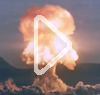
The following video describes the long duration of the thermal pulse from a high yield nuclear weapons in comparison to low yield tests during Operation Castle in 1954. Palm trees are shown igniting, birds can be seen being incinerated mid-flight and falling from the sky. This is an excerpt from the DOE film 'Operation Castle Military Effects' produced by Lookout Mountain Laboratory -
Nuclear Radiation
Radiation interacts with photographic films in the same fashion that ordinary light does. Gamma and x-rays are of course also light, but of a higher frequency and penetrative power. The 'fogging' this causes can be mitigated by protecting the film using lead shielding, and by using films designed to be insensitive to radiation. EG&G developed a black and white film in conjunction with Eastman Kodak called 'Type 918', which could absorb 600 times more radiation than conventional film without fogging. The downside of this film type is its relative insensitivity, obviously not a big problem in the context of a close range nuclear detonation.
The issues associated with the detrimental effects of radiation on film and its successful recovery are far greater with megaton range detonations. These multi-megaton tests conducted in the Pacific were multiple orders of magnitude more powerful than those conducted on the US mainland. These enormous detonations showered huge quantities of radioactive fallout across the atolls they were tested on.
A significant amount of planning and logistics was required to keep operational personnel safe from radiological hazards during testing. Even if your cameras and film are protected from the radiation, they still need to be safely recovered without injury.
Shockwave
The blast wave is an expanding sphere of highly compressed and fast moving air produced by the fireball. Initially the blast wave travels at several times the speed of sound, decreasing as it slows with distance. Sound travels significantly slower that light creating an unnerving experience for the observer witnessing the awe-inspiring sight of the fireball in complete silence. For kiloton range detonations, depending on ambient air temperature and humidity, the sound/blast would arrive multiple tens of seconds after the initial flash. For detonations in the megaton range this delay could be several minutes.
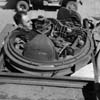
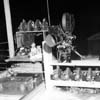
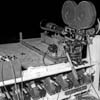
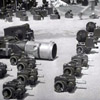
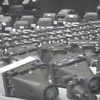
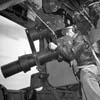
Filming at close proximity creates very real potential for the destruction of the camera by the blast. One solution was to use the GSAP (Gun Sight Aiming Point) camera that had been used on WWII aircraft to record air combat. These cameras were small, tough, cheap, electrically triggered, capable of variable frame rates from 16 to 64 fps, and abundant due to post-war surplus. They typically used a cartridge containing 50 feet of 16mm Kodak film, and a 35mm f/3.5 lens set at infinity. Their small size made them easier to shield from radiation and blast damage, and ran on 24 volt DC making them suitable for battery operation. There are accounts of GSAPs being torn from their mounts and thrown a significant distance, but still kept operating regardless. Their semi-disposable nature made them an ideal camera to use at close range.
GSAP cameras can be seen from 00:27, with one torn from it's mounts at 00:32 -
One blast analysis technique seen in the photographic records was to use rockets to produce smoke trails. Distortions in these smoke trails caused by changes in the refractive index of air produced data on the progress of the expanding shockwave. This optical phenomena could be observed even without the assistance of smoke trails, but required the aid of high speed photography.
Photographic analysis of the blast wave, revealed phenomena that could be exploited to increase the destructive effects of a nuclear weapon -
- The initial blast, expanding out like a bubble, reflects off the ground reinforcing the incident wave forming a 'Y' shaped front known as the Mach Y Stem. There were other considerations such as reducing fallout, but increased blast damage was the main reason both the weapons used against Japan were detonated at altitude. Even though this phenomenon was understood, testing during the 1950s was used to refine height of burst (HOB) graphs for use in potential nuclear combat theaters.
- The initial thermal pulse can raises a dust layer close to the ground. This can cause a modification of the blast wave with the formation of an auxiliary or 'precursor' wave that precedes the incident shock front. This could be utilized to increase damage to drag sensitive ground targets.
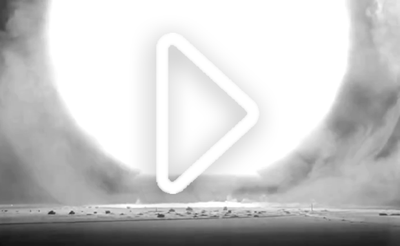
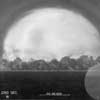
Shot Grable reflected shockwave and blastline
|
This article is inspired by the book 'How To Photograph an Atomic Bomb' by Peter Kuran.
|
|
|
|













 camera and film cartridge)

